RRA Requirements – Overview
South Korea applies a strict approval system for radio and telecommunications equipment. Wireless products must obtain certification from the Radio Research Agency (RRA) to be legally placed on the Korean market and bear the KC mark.
RRA approval confirms compliance with national spectrum regulations, radio performance requirements, and EMC rules under the Radio Waves Act. Early clarification of the applicable certification scheme and local testing requirements helps avoid delays during market entry.
Note: Electrical safety is regulated separately under Korea’s safety framework administered by KATS. RRA certification covers radio, EMC, and RF exposure; depending on the product, additional KC safety certification may be required.
Key Takeaways
Mandatory RRA approval: Most radio equipment and certain telecom or non-radio devices require RRA approval and KC marking before import and sale in South Korea.
Certification schemes: Products fall under Conformity Certification, Registration of Compatibility (not equivalent to FCC SDoC), or Interim Certification, depending on risk and applicable standards.
KC marking & validity: Approved products receive a KC certification number and are listed in the RRA database. Certificates have no fixed expiry but must be updated if the product or regulations change.
Local testing required: In-country testing at a Korea-accredited lab is typically required; acceptance of foreign test reports is limited and subject to specific conditions.
Local representation & Korean documentation: A Korean applicant is typically required, and Korean-language requirements apply mainly to user-facing documentation and labeling.
In summary: RRA approval is required for most radio-enabled products in South Korea and typically involves local testing, a Korean applicant, and KC marking prior to market entry.
The following sections outline the regulatory framework, scope of application, applicable standards, and the RRA certification process in detail.
Need support?
Guidance on RRA certification, including local representation, in-country testing coordination, Korean documentation, and KC labeling. → KC Certification Services
Regulatory Framework
South Korea maintains a stringent regulatory framework for wireless and telecommunications equipment. Regulatory oversight is exercised by the Radio Research Agency (RRA) under the Ministry of Science and ICT (MSIT).
The RRA ensures compliance with national requirements for spectrum use, radio performance, electromagnetic compatibility (EMC), and RF exposure under the KC conformity system.
| Actor / Element | Details |
|---|---|
| MSIT (Ministry) | Key Responsibilities: Responsible for overall ICT policy and for issuing MSIT Notices that define the technical conditions and standards framework. |
| RRA1 (Authority) | Key Responsibilities: Responsible for spectrum use, radio performance, EMC, and RF exposure compliance; issues KC certification and conducts post-market surveillance. |
| KATS2 (Safety) | Key Responsibilities: Responsible for electrical safety certification under the KC system. |
| KC System3 |
Role: Unified National Conformity Marking Key Responsibilities: Required for market access; covers Radio Waves Act compliance (via RRA) and electrical safety requirements (via KATS). |
| Legal Basis |
Framework: Radio Waves Act (Article 58-2) Key Responsibilities: Includes subordinate conformity assessment regulations governing broadcasting and telecommunications equipment. |
| Element | Authority | Description & Responsibilities |
|---|---|---|
| Responsible Ministry | MSIT | Ministry of Science and ICT; responsible for overall ICT policy and for issuing MSIT Notices that define the technical conditions and standards framework. |
| Competent Authority | RRA1 | Radio Research Agency; responsible for spectrum use, radio performance, EMC, and RF exposure compliance; issues KC certification and conducts post-market surveillance. |
| Safety Authority | KATS2 | Korea Agency for Technology and Standards; responsible for electrical safety certification under the KC system. |
| Certification Scheme | KC System3 | Unified national conformity marking required for market access; covers Radio Waves Act compliance (via RRA) and electrical safety requirements (via KATS). |
| Legal Basis | Radio Waves Act | Article 58-2, including subordinate conformity assessment regulations governing broadcasting and telecommunications equipment. |
Notes:
1 RRA: The Radio Research Agency was formerly under the KCC (Korean Communications Commission). Responsibilities for radio and telecom conformity were transferred to RRA.
2 KATS: Responsible for the safety portion of KC marking, which often applies alongside RRA radio and EMC requirements for electronic devices.
3 KC Marking: South Korea’s unified certification mark. For wireless devices, it is comparable in function to CE marking in the European Union or FCC authorization in the United States.
This regulatory structure defines the mandatory path for spectrum use, radio performance, EMC, and RF exposure (including SAR), which must be maintained throughout the product lifecycle and may be subject to re-evaluation in case of relevant product changes or post-market surveillance.
Certification Objectives and Enforcement
The RRA conformity assessment framework defines the regulatory objectives that radio and telecommunications equipment must meet before being placed on the South Korean market. These objectives form the basis for certification, surveillance, and enforcement activities under the Radio Waves Act.
Regulatory objectives
Radiofrequency management
Ensuring efficient spectrum use and preventing harmful interference. Devices must operate within assigned frequency bands and power limits and support mandatory interference-mitigation mechanisms where required.Electromagnetic Compatibility (EMC)
Preventing electromagnetic disturbances that could adversely affect other equipment. Products must comply with Korean EMC limits to ensure reliable operation in shared electromagnetic environments.Electrical safety (interface to KATS)
Protecting users from electrical hazards. Where applicable, compliance with electrical safety requirements under the KC framework is required in parallel to RRA approval.Network protection and interoperability
Telecommunications terminal equipment must meet technical requirements to avoid adverse effects on public networks and to ensure interoperability with network infrastructure.Consumer information and traceability
Clear identification of the responsible manufacturer or importer and provision of Korean-language user and safety information to ensure transparency and regulatory accountability.
Enforcement and market surveillance
Compliance is actively enforced through inspections and market surveillance activities. Products that do not match their approved configuration, lack valid certification, or fail to meet applicable requirements may be denied import, subject to corrective measures, recalled, or penalized in accordance with Korean regulations.
Scope and Applicability
RRA conformity assessment primarily applies to radio and telecommunications equipment that uses radio waves and is placed on the South Korean market. In addition, certain non-radio devices (e.g., wired telecommunications or EMC-relevant products) may also fall within scope depending on applicable regulations.
In principle, products that intentionally transmit or receive radio signals fall within the scope of the Radio Waves Act.
Equipment within scope
The following product categories typically require RRA approval under the KC conformity system:
Radio transmitters and receivers, including short-range and wide-area wireless technologies
Telecommunications terminal equipment connected to public networks
Integrated radio modules installed in host products
Consumer electronics and IoT devices with wireless functionality
Both standalone devices and embedded radio components are covered, regardless of whether the radio function is the primary purpose of the product.
General applicability rule
As a general rule, most radio-enabled products supplied commercially in South Korea require RRA approval prior to importation or sale, unless a specific exemption explicitly applies.
Limited exemptions may exist for certain use cases (such as research, prototyping, or non-commercial imports), but these are narrowly defined and subject to strict conditions.
Conformity Assessment Categories
Under the Radio Waves Act, radio and telecommunications equipment in South Korea is subject to three conformity assessment categories. The applicable path depends on the product’s radio characteristics, interference risk, and the availability of Korean technical standards.
| Category | Details |
|---|---|
| Certification of Conformity (CoC) |
When it applies: Higher-risk radio equipment (e.g., transmitters and most wireless communication products). Evidence / Testing: Testing at an authorized laboratory and submission to RRA. Outcome: Formal RRA certificate and KC certification number. |
| Registration of Compatibility |
When it applies: A simplified conformity assessment procedure for lower-risk equipment (not equivalent to FCC SDoC) Evidence / Testing: Compliance evidence (often self-testing or third-party testing) and registration of a Letter of Conformance with RRA. Outcome: Product registered in the RRA database; no formal certificate issued, but KC marking and compliance obligations apply. |
| Interim Certification |
When it applies: No applicable Korean technical standard exists (e.g., emerging technologies). Evidence / Testing: RRA may accept equivalent foreign standards or alternate criteria, subject to review. Outcome: Conditional or time-limited approval under defined conditions. |
| Category | When it applies | Evidence / Testing | Outcome |
|---|---|---|---|
| Certification of Conformity (CoC) | Higher-risk radio equipment (e.g., transmitters and most wireless communication products). | Testing at an authorized laboratory and submission to RRA. | Formal RRA certificate and KC certification number. |
| Registration of Compatibility | A simplified conformity assessment procedure for lower-risk equipment (not equivalent to FCC SDoC) | Compliance evidence (often self-testing or third-party testing) and registration of a Letter of Conformance with RRA. | Product registered in the RRA database; no formal certificate issued, but KC marking and compliance obligations apply. |
| Interim Certification | No applicable Korean technical standard exists (e.g., emerging technologies). | RRA may accept equivalent foreign standards or alternate criteria, subject to review. | Conditional or time-limited approval under defined conditions. |
Note: Limited exemptions from conformity assessment may apply in narrowly defined cases and must be assessed individually.
KC Marking and Certification Database
KC marking requirements
Once RRA approval has been granted, the certified product must be marked in accordance with the KC conformity system before it is placed on the South Korean market. KC marking is mandatory and serves as visible proof that the product complies with applicable requirements under the Radio Waves Act and, where relevant, electrical safety regulations.
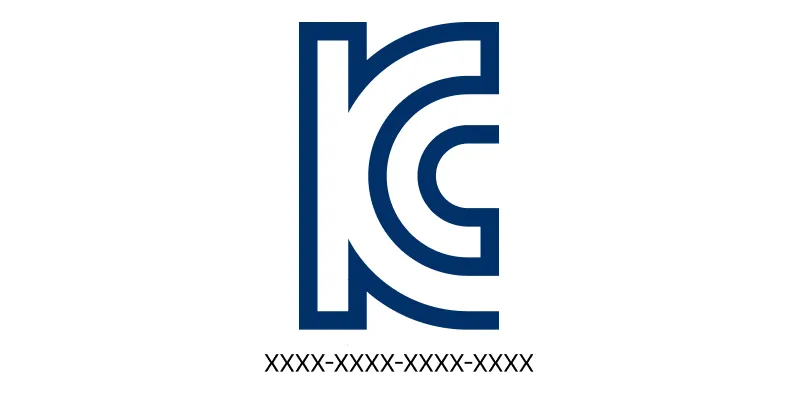
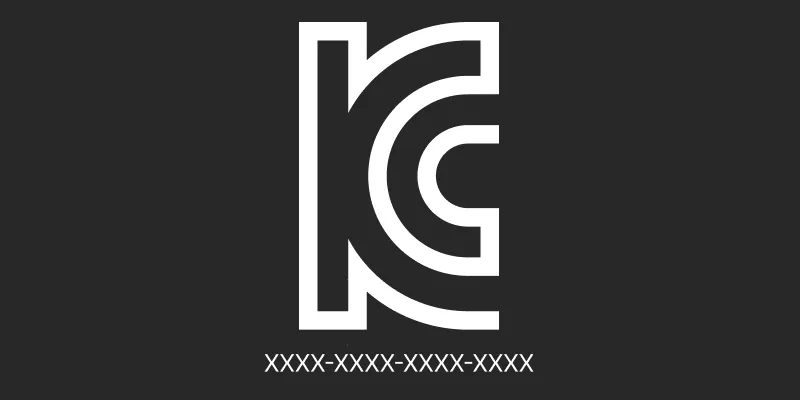
Key marking requirements include:
KC symbol
The KC mark must be permanently affixed to the product in a clearly visible and legible manner. It is typically placed on the rating label or device enclosure.KC certification number
The unique certification number assigned as part of the approval process must be displayed together with the KC symbol. This identifier links the product to its approval record in the RRA database.Manufacturer or importer identification
The name of the certificate holder and, where applicable, the Korean importer or local representative must be indicated to ensure regulatory accountability.Language requirements
Mandatory labeling information and accompanying documentation must be provided in Korean. The KC symbol itself is exempt from language requirements.Exceptions for small devices
If physical marking on the device is not feasible due to size or construction, alternative placement (such as packaging or user documentation) may be permitted, subject to specific RRA labeling rules.
RRA certification database (eKCC)
In addition to physical marking, all approved products are registered in the RRA’s online certification database (commonly referred to as the eKCC system). The database entry is an integral part of the approval process and enables verification of certification status.
Key aspects of database registration include:
Mandatory listing
Each approved product is listed with its KC certification number, product designation, and certificate holder details.Verification by authorities and customs
Customs authorities and market surveillance bodies routinely verify products against the RRA database. Products that are not listed or do not match their approved configuration may be denied import or flagged as non-compliant.Public traceability
The database allows regulators, distributors, and business partners to confirm the approval status of a product using the KC certification number.
Compliance relevance
Both KC marking and database registration are mandatory. Physical labeling without a corresponding database entry, or a database entry without correct product marking, is considered non-compliant. Manufacturers and local representatives must ensure ongoing consistency between the approved configuration, the product labeling, and the database record throughout the product lifecycle.
RRA Certification Process (Step-by-Step)
The RRA certification process follows a defined sequence from scope determination and testing to application review, KC number issuance, and market entry requirements.
Detailed Certification Process
Key Process Requirements
- Local Applicant: Non-Korean manufacturers typically appoint a Korean entity as the applicant
- In-Country Testing: Compliance testing at RRA-accredited Korean laboratories is typically required
- Korean Documentation: User-facing documentation must be in Korean; technical documents may remain in English where applicable
- eKCC System: All applications submitted electronically through RRA's online portal
- KC Marking: Certified products must display KC mark with certification number before sale
Timeframes provided are typical estimates and may vary based on product complexity and documentation completeness.
In-Country Laboratory Testing
Laboratory Requirements
South Korea requires local testing for virtually all radio equipment certifications. Compliance testing must be conducted at laboratories accredited or designated by the Radio Research Agency or recognized Korean accreditation bodies.
Sample Submission and Test Execution
The manufacturer provides sample units to the test laboratory. The number of samples depends on the product and required test scope, typically one to two units for most wireless devices. Testing is performed according to Korean technical requirements and test methods.
Test Scope
Depending on the product, the test scope may include radio performance tests (output power, spurious emissions, bandwidth), EMC tests, electrical safety tests, RF exposure assessments such as SAR, and telecom interface tests where network connection is involved.
Test Reports
Test reports are issued in Korean and follow RRA-defined formats. Foreign test reports (e.g. FCC or CE) are generally not accepted as substitutes. Even where mutual recognition agreements exist, RRA may still request additional local testing.
Application Submission
Submit via eKCC System
After completion of testing, the local representative submits the certification application electronically via the eKCC system. The submission package typically includes test reports issued by the accredited Korean laboratory, technical documentation, Korean-language user manuals, labeling information, and company registration documents of the applicant.
Document Consistency
The application form consolidates product details such as model name, manufacturer information, frequency bands, and laboratory references. Consistency across all documents is critical; even minor discrepancies can result in clarification requests or re-submission.
Fees
An administrative processing fee is paid as part of the submission. Testing and translation costs are handled separately and are borne by the manufacturer.
RRA Review and Certification
Documentation Review
RRA reviews the submitted documentation and test results for completeness and compliance with applicable standards. If the submission is satisfactory, RRA issues a Certificate of Conformity and assigns a KC certification number.
Clarifications and Corrections
If issues are identified, RRA may request clarifications, corrections, or additional testing. Once approved, the certification has no fixed expiry date but remains valid only as long as the product configuration and applicable standards remain unchanged.
Database Entry
Approved products are entered into the national RRA certification database and become publicly searchable. At this point, the product is formally approved for the South Korean market.
Labeling, Importation, and Post-Certification Compliance
Product Labeling
After certification, the product must be labeled with the KC mark and the assigned certification number before importation or sale. Labeling must comply with RRA requirements and include Korean-language information where required.
Import Clearance
With proper certification and labeling in place, the product may be imported into South Korea. Customs authorities routinely verify KC compliance during import clearance.
Post-Market Compliance
Post-certification, manufacturers and local representatives must ensure that all production units remain consistent with the approved configuration. Changes to RF characteristics, hardware design, or firmware—particularly for products subject to SAR requirements—may trigger re-testing and re-evaluation. RRA conducts market surveillance and may request corrective actions if non-compliance is identified.
Key Considerations and Edge Cases
Registration vs. Certification
Registration of Compatibility applies to lower-risk equipment and does not result in a formal certificate. Most intentional radio transmitters require full Certification of Conformity.
Firmware Updates and Re-Certification Triggers
Changes affecting RF behavior, operating bands, output power, or SAR-relevant characteristics may require re-testing and re-approval.
Market Surveillance
RRA conducts post-market surveillance and may inspect products offered for sale. Devices must remain consistent with the approved configuration.
Typical Failure Scenarios
Common causes of delays include incomplete Korean documentation, inconsistent model names, missing test coverage for all operating modes, and late design changes.
Required Documents & Evidence
Documentation Overview by Stage
- Testing Preparation: Technical specs, photos, samples
- Conformity Testing: Test plans and reports
- RRA Application: eKCC forms, user manuals, Letter of Authorization
- Approval & Post-Certification: Certificate, KC labels, import docs
Conformity Testing
Test Evidence
- Test plan according to applicable Korean requirements
- Official test reports issued by an accredited laboratory
- Additional reports where applicable (EMC, SAR, electrical safety)
Responsible Party: Accredited Korean laboratory
RRA Application
Application Package
- Completed application form (eKCC)
- Official test reports
- User manual
- Product specification and technical documentation
- Letter of Authorization for local representative (if applicable)
- Business registration certificate of Korean applicant
- KC label artwork
- Proof of fee payment
Responsible Party: Local representative / Applicant
Approval & Post-Certification
Approval Evidence
- RRA Certificate of Conformity or registration confirmation
- Finalized product label with KC mark and certification number
- Updated user manual including certification information
- Import documentation for customs clearance
Responsible Party: RRA (approval issuance); Manufacturer / Importer (labeling and ongoing compliance)
Language and Format Requirements
User manuals, labeling information, and application forms must be provided in Korean. Technical documentation (e.g., drawings, schematics, circuit diagrams) may remain in English if they are internationally standardized.
Test reports must follow RRA-defined formats, which are typically fixed by laboratory templates.
Notable Requirements and Clarifications
User Manual
Must include operating instructions and safety warnings in Korean.
Full translation is required for consumer products; partial localization may be accepted for professional or industrial equipment at RRA’s discretion.Local Representative Documentation
Foreign manufacturers must submit a Letter of Authorization naming a Korean entity as the responsible applicant and formal point of contact for RRA.ISO Certificates
ISO 9001 or factory audit certificates are not generally required for RRA radio and EMC approval.
Separate electrical safety certification under KATS may introduce additional factory-related requirements, outside the RRA scope.Foreign Test Reports
Test reports issued outside Korea are generally not accepted.
Even under Mutual Recognition Agreements (MRAs), additional Korean testing or localized summaries may be required.Data Consistency
Product name, model number, frequency information, and labeling details must be identical across test reports, application forms, and product labels.
Minor inconsistencies can trigger clarification requests or document re-issuance.
By preparing a complete and consistent documentation package upfront, applicants can significantly reduce review cycles, avoid re-testing, and ensure smooth processing through the RRA certification workflow.
Product Changes, Variants & Lifecycle Obligations
Key Considerations
- Product Variants: Limited variants acceptable if technically equivalent
- Hardware Changes: RF-impacting changes trigger re-testing
- Firmware Updates: Power/frequency/DFS changes require re-approval
- Antenna Changes: Type/gain/placement changes need re-certification
- Post-Market Surveillance: RRA monitors compliance after approval
Hardware Changes After Certification
Hardware changes are assessed based on their impact on RF, EMC, and safety characteristics.
Changes That Usually Trigger Re-Testing or Re-Approval
- RF chipset or module replacement
- Antenna redesign or gain change
- PCB layout changes affecting RF paths
- Power supply or clocking changes impacting emissions
Changes That May Not Require Re-Testing (Subject to Review)
- Mechanical enclosure changes without RF impact
- Connector or labeling changes only
Action: Any hardware change should be documented and reviewed against the approved test configuration before production.
Firmware Updates and Re-Certification Triggers
Firmware changes are a frequent source of non-compliance findings.
Firmware Changes That May Require Re-Testing
- Changes affecting RF output power or duty cycle
- Modified frequency usage or channel selection
- DFS, TPC, or region-lock behavior changes
- SAR-related control logic modifications
Firmware Changes Typically Acceptable Without Re-Testing
- UI changes
- Bug fixes unrelated to RF behavior
- Security patches without RF impact
Critical: Firmware must enforce Korean regulatory limits (frequency, power, DFS/TPC) consistently. Region-based or configurable firmware must not allow end-user modification beyond approved parameters.
Antenna Changes
Antenna configuration is considered a core approval parameter.
Re-Approval Typically Required For
- Antenna type changes (internal ↔ external)
- Gain increase
- New antenna models or suppliers
- Different antenna placement affecting radiation characteristics
Action: Only antennas explicitly covered in the test report and approval may be used for production units.
Post-Market Surveillance and Responsibilities
RRA conducts market surveillance activities, including product inspections and documentation reviews.
Key Obligations
- Products placed on the market must match the approved configuration
- KC marking and certification number must remain visible and correct
- Documentation must be available upon request
- The local applicant or representative acts as the primary compliance contact
In Case of Non-Compliance
- Corrective actions may be required
- Sales suspension or product recall may be ordered
- Certification may be withdrawn for repeated or severe violations
Lifecycle Best Practices
- Freeze RF-relevant design before Korean testing
- Maintain strict configuration control for hardware and firmware
- Align variant strategy early with the test laboratory
- Treat firmware updates as compliance-relevant changes
- Keep clear traceability between approval, test reports, and production units
FAQ – Practical Questions
Do all wireless devices require RRA certification?
Most radio-enabled products placed on the South Korean market require RRA approval. Only limited exemptions apply, such as certain R&D prototypes, personal imports, or export-only equipment.
Are foreign test reports (FCC or CE) accepted?
No. RRA generally requires testing at accredited Korean laboratories. Foreign test reports are not accepted as substitutes, even if the product is already certified in other regions.
Is a local representative mandatory for foreign manufacturers?
A Korean applicant (local entity or importer) is typically required for certification and submission handling. The local representative is responsible for application submission and post-market compliance.
How long does the RRA certification process take?
The end-to-end process typically takes around 4–8 weeks, depending on test scheduling, product complexity, and the completeness of documentation.
Does RRA certification expire?
No fixed expiry date applies. Certification remains valid as long as the approved product configuration and applicable regulatory requirements remain unchanged.
Do firmware updates require re-certification?
Firmware updates that affect RF behavior, frequency usage, output power, DFS/TPC functions, or SAR-related controls may require re-testing and re-approval.
Can multiple product variants be covered under one approval?
Only if technical equivalence can be clearly demonstrated. Variants with different RF characteristics generally require separate approvals.
Further Reading & Official Resources
Official RRA Resources
-
Radio Research Agency (RRA) – Official Website
Available at: https://www.rra.go.kr/
-
Ministry of Science and ICT (MSIT) – Regulatory Authority
Available at: https://www.msit.go.kr/
-
KATS – Electrical Safety Certification (KC Safety)
Available at: https://www.kats.go.kr/
Additional Resource
-
TAMSys by IB-Lenhardt AG – Type Approval Management System
Centralized compliance platform for certificate tracking, regulatory data, and lifecycle management across global markets. → TAMSys – Type Approval Management System
This is a curated selection of key regulatory and technical resources. For legally binding and up-to-date requirements, always refer to the official publications and databases of the responsible Korean authorities. All references were verified as of February 2026.
Author: IBL-Editors Team
Technical Review: Keshia Bauer - Certification Specialist | IB-Lenhardt AG Give feedback on this article